· Ahmed Chaabni · Business Strategy · 8 min read
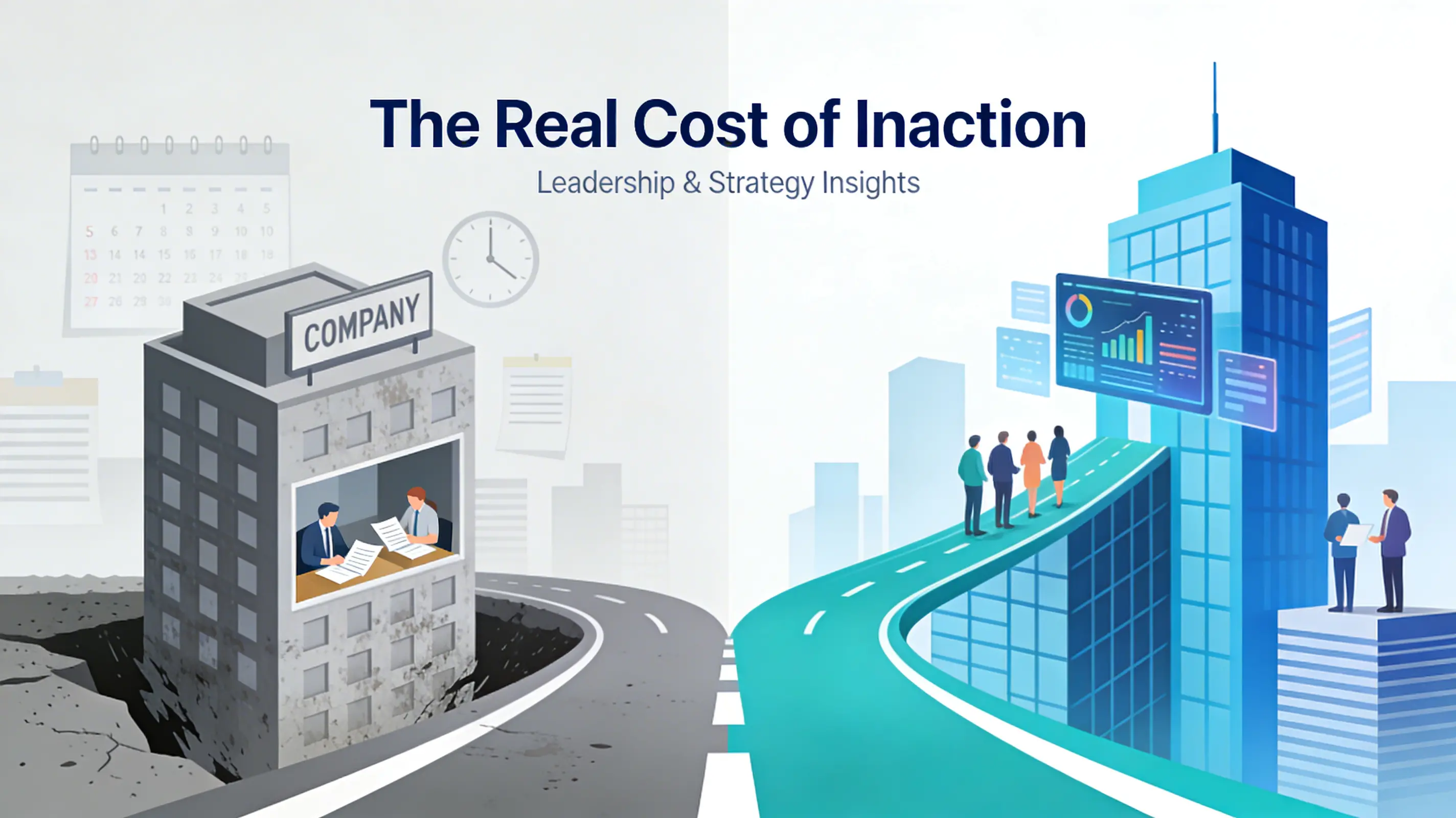
The Real Cost of Inaction: Why Doing Nothing Is So Expensive
Most leaders obsess over ROI of new initiatives but ignore the hidden costs of maintaining the status quo. Discover how inaction erodes growth, competitiveness, and resilience faster than most realise.
- 1What Is the Cost of Inaction?
- 2Why Doing Nothing Feels Safer (And Why It Is Not)
- 3The Hidden Costs: Where Inaction Hits Your Business
- 41. Competitive Disadvantage Compounds Over Time
- 52. Financial Drag and Missed Revenue
- 63. Operational Inefficiency and Technical Debt
- 74. Risk, Security, and Compliance Exposure
- 85. Talent, Culture, and Engagement
- 9The Cost of Inaction in Digital Transformation
- 10Why the Cost of Inaction Is Hard to See
- 11A Simple Framework to Quantify Your Cost of Inaction
- 121. Financial Lens
- 132. Operational and Customer Lens
- 143. Strategic and Talent Lens
- 15Turning Insight into Action: How To Reduce the Cost of Inaction
- 16Conclusion: Inaction Is Not Neutral
What Is the Cost of Inaction?
The Cost of Inaction is the tangible and intangible price you pay for maintaining the status quo when change is needed. It shows up in several ways:
- Direct financial losses, such as missed revenue and higher operating costs
- Wasted time and resources on outdated processes
- Missed opportunities in markets, products, or partnerships
- Increased risk, from security incidents to compliance failures
- Growing competitive disadvantage as others move faster
Unlike a budget line item, these costs rarely appear as a single number. They accumulate over months and years, quietly eroding performance until the gap is too big to ignore.
Why Doing Nothing Feels Safer (And Why It Is Not)
If inaction is so costly, why is it so common?
Common reasons leaders delay decisions include:
- Resistance to change from teams who feel overloaded already
- Fear of disruption or short term productivity dips
- Uncertainty around the business case or return on investment
- Lack of clarity in strategy and priorities
- A sense that current systems are “good enough for now”
In the moment, postponing a decision can feel prudent. There is no immediate disruption, no pushback, no visible risk. But as multiple authors on digital transformation and strategy note, the risk of change is usually smaller than the risk of staying the same.
The Hidden Costs: Where Inaction Hits Your Business
1. Competitive Disadvantage Compounds Over Time
Markets do not stand still. When competitors adopt new capabilities while you wait, the performance gap grows each quarter.
Studies on digital transformation show that organisations with mature digital processes achieve 20 to 40 percent higher productivity in routine operations, and large enterprises that delay comprehensive transformation can face 15 to 25 percent higher operational costs than digital leaders in their sector. Over time, this is not just a margin issue. It becomes a structural handicap that is hard to reverse.
2. Financial Drag and Missed Revenue
Inaction has clear financial consequences:
- Stagnant or declining revenue as offers fall behind market expectations
- Shrinking margins as inefficiencies increase costs
- Underutilised assets and tools that never reach their potential
- Opportunity costs when promising initiatives stay unfunded or unlaunched
McKinsey and others note that companies that fail to innovate see revenue growth stall and profit margins erode over time. By the time these trends show up clearly in financial statements, years of inaction are already baked in.
3. Operational Inefficiency and Technical Debt
Delaying modernisation or process redesign tends to create heavier operational burdens over time:
- Higher labour costs as staff compensate for outdated systems
- Duplicate processes and manual workarounds that waste capacity
- Higher error rates and rework from manual steps
Analyses of digital laggards show they incur 20 to 30 percent higher administrative costs due to process duplication and redundancy, while organisations with high levels of automation see dramatically fewer errors in core operations. Each year of delay increases this “inefficiency tax.”
4. Risk, Security, and Compliance Exposure
Old processes and legacy systems often carry hidden risk:
- Increased vulnerability to cyberattacks due to unpatched or unsupported technology
- Higher incident and recovery costs when something goes wrong
- Greater likelihood of noncompliance as regulations evolve faster than systems
Research has found that organisations with high technical debt and legacy systems suffer significantly higher costs per data breach than peers with modernised environments. Inaction on modernisation is not neutral. It increases both the likelihood and the price of negative events.
5. Talent, Culture, and Engagement
Inaction is not just a systems problem. It is a culture signal.
Leadership development, process improvement, and tool upgrades often get pushed to “next year’s budget.” Over time, that leads to:
- Higher turnover as top performers leave for more progressive environments
- Stagnant cultures where employees adapt around broken systems instead of improving them
- Frustration and disengagement, which translate into lost productivity
Gallup estimates that actively disengaged employees cost businesses hundreds of billions annually in lost productivity, driven in part by poor systems and weak leadership development. Choosing not to invest in growth sends a message: this is as good as it gets.
The Cost of Inaction in Digital Transformation
Digital transformation is a clear and current example of how inaction plays out.
Advisory firms and industry analyses consistently point out that while most boards now include digital initiatives in their growth strategies, only a minority are on track to achieve their transformation goals. Reasons include:
- Budget constraints and competing priorities
- Unclear or weak business cases
- Cultural reluctance, with teams insisting current tools are fine
- Information overload and fear of picking the “wrong” technology
The price of standing still in digital contexts includes:
- Widening performance gaps as competitors use data and automation to make better, faster decisions
- Lower customer satisfaction and higher churn, especially where digital experiences lag
- Higher ongoing costs to maintain fragmented, legacy environments
- Growing reputational risk as user expectations rise while your experience remains static
In sectors like banking and financial services, this stagnation in user experience and digital branding has already led to significant customer losses and rising service costs for organisations that postponed updates too long.
Why the Cost of Inaction Is Hard to See
The Cost of Inaction is often invisible because it hides inside current metrics and habits:
- Losses are spread over many small incidents, not one dramatic failure
- The “as is” state feels normal, so inefficiencies blend into routine noise
- Reports usually track new spending, not the money silently leaking from outdated ways of working
Consultants sometimes use “Cost of Doing Nothing” frameworks to expose these hidden losses by quantifying financial, operational, and reputational impacts of staying still. Once leaders see the cost on paper, apparent “risky” investments often look like the safer choice.
A Simple Framework to Quantify Your Cost of Inaction
You do not need a complex model to start making the Cost of Inaction visible. Begin with three lenses.
1. Financial Lens
Ask:
- What revenue are we missing because we cannot offer something our competitors already provide?
- Where are we discounting, losing deals, or failing to renew because our product, service, or process feels outdated?
- Which costs are higher than they should be because of manual work, rework, or legacy systems?
Estimate:
- Lost revenue per month from delayed capabilities or market entry
- Extra labour or operational costs that could be removed with better tools or processes
- One time financial impacts from incidents that a change could reduce
2. Operational and Customer Lens
Ask:
- How many hours per week do teams spend on activities that could be automated or streamlined?
- Where are errors or delays undermining customer experience?
- What is the impact on service quality and response time compared to competitors?
Estimate:
- Hours saved per person, multiplied by fully loaded cost
- Customer churn or lower lifetime value driven by poor experience
- The effect of delays on sales cycles, onboarding, or delivery times
3. Strategic and Talent Lens
Ask:
- Which strategic priorities are stuck because of outdated systems or ways of working?
- Which key people have left, or are at risk of leaving, because they are blocked or frustrated?
- How is inaction affecting your reputation as an employer or partner?
Estimate:
- Value of delayed or cancelled strategic initiatives
- Cost to replace and ramp up critical roles that leave
- Brand and relationship damage that shows up as longer sales cycles or lower win rates
Even rough calculations can reveal that delaying a project that costs six figures this year may be burning multiples of that amount every year you wait.
Turning Insight into Action: How To Reduce the Cost of Inaction
Recognising the Cost of Inaction is useful only if it leads to better decisions. A practical approach:
Name one high impact area
Choose a domain where pain is already visible, such as customer experience, operations, or leadership capability.Quantify the “do nothing” scenario
Use the lenses above to map financial, operational, and strategic impacts over a realistic time frame, such as 2 to 3 years.Compare against a credible “take action” scenario
Define a focused initiative with clear scope and outcomes. Include implementation costs, change effort, and realistic timelines.Bring both cases to stakeholders
Present not only the return on investment, but also the Cost of Inaction as a separate figure. Make the trade off explicit: what you spend versus what you continue to lose if you delay.Start smaller, but start
If a full transformation feels too large, design a phased approach. Pilot in one business unit or process. The goal is to move out of paralysis and into learning.Build a habit of measuring COI
Integrate Cost of Inaction thinking into your regular planning and review cycles. Whenever you consider deferring a decision, ask what that delay will realistically cost.
Conclusion: Inaction Is Not Neutral
Every organisation reaches points where the way forward is not about tweaking dashboards or writing another strategy document. It is about confronting a simple question: what is the real cost of staying as we are?
In uncertain times, choosing not to act can feel like the safest option. In reality, it is often the most expensive. While you postpone, competitors adapt, technology moves on, customer expectations rise, and your best people decide to apply their energy elsewhere.
The Cost of Inaction is paid in lost opportunities, declining relevance, and a future where catching up is far harder than starting earlier would have been. The most resilient organisations recognise this. They do not chase every trend, but they rarely accept paralysis. They quantify the price of delay, make the hidden visible, and choose movement over stagnation.
The question is not whether you can afford to invest in change. It is whether you can afford not to.
Ready for More Insights?
If you found this article helpful, explore our Blog for more functional and technical articles.
Sources
- [1]The Hidden Cost of Inaction
- [2]The Real Cost of Avoiding Change
- [3]Hidden Costs of Delaying Digital Transformation
- [4]Cost of Inaction in Business Strategy
- [5]Hidden Cost of Doing Nothing in Leadership
- [6]The Price of Digital Hesitancy
- [7]The Cost of Inaction in Business
- [8]Why Doing Nothing Costs More
- [9]Hidden Cost in UX and Digital Banking
- [10]Cost of Inaction in Sales
- [11]The Cost of Inaction (Why Doing Nothing Sends You Backwards)
- [12]Future of Digital Transformation Costs
- [13]Cost of Inaction and Business Stagnation
- [14]If You Knew the Cost of Doing Nothing
- [15]Top 5 Hidden Costs of Delaying Digital Transformation